
Understanding How Multiple IRP5s Can Impact Your 2025 Tax Return

As we progress through the 2025 tax season (March 2024 – February 2025), understanding how multiple IRP5s can impact your 2025 Tax Return becomes critical. Whether you’ve worked for multiple employers or have additional sources of income generating IRP5s, this could result in a higher tax liability than you might expect. How Multiple IRP5s Affect Your Tax Return Each employer deducts PAYE (Pay-As-You-Earn) based solely on the income they pay you, without considering any additional income you may earn from other employers or sources. However, when you submit your tax return, SARS aggregates all your income to calculate your total taxable income. This approach can lead to the following scenarios: 1. The Tax Due May Increase When SARS combines all your income, your taxable income may push you into a higher tax bracket, resulting in an increased tax liability. 2. Additional Tax May Be Payable The PAYE deducted by each employer might not cover the total tax due across all sources of income. As a result, you could face an additional tax payment when you file your return. What You Can Do to Avoid Surprises To avoid unexpected tax bills during filing season, it’s essential to plan ahead. Here are some steps to help you stay prepared: 1. Review Your Income Early Aggregate your income from all sources to estimate your total taxable income for the year. This gives you a clearer picture of what to expect when SARS calculates your tax liability. 2. Calculate the Tax Due Use SARS tax tables or consult a tax professional to determine the total tax you are likely to owe at the end of the year. 3. Set Aside Additional Funds If your estimated tax liability exceeds the PAYE already deducted, consider setting aside the difference. This ensures you’re prepared to cover any shortfall when you file your return. 4. Consider Provisional Tax If you’re registered as a provisional taxpayer, ensure you declare all sources of income in your provisional tax returns. This allows you to manage your tax liability in advance and reduce any large year-end surprises. Stay Ahead of Your Taxes for 2025! Understanding how multiple IRP5s affect your tax return can save you from unnecessary stress and financial surprises. By taking the time to review your income, estimate your tax liability, and plan ahead, you’ll be in a better position to manage your taxes efficiently. With multiple IRP5s, your tax return may bring unexpected surprises. Ensure you’re prepared for the 2025 tax season by reviewing your income, calculating your tax due, and setting aside additional funds if needed. Need help navigating your tax obligations? Contact us today for expert guidance and personalized support!
Smart Tax Planning for Small Businesses: Managing VAT and Staying Prepared Year-Round

Smart Tax Planning for Small Businesses: Managing VAT and Staying Prepared Year-Round Running a small business comes with its fair share of responsibilities, and one of the biggest challenges is staying on top of VAT and other tax obligations. Many business owners find it difficult to consistently set aside funds for taxes, often facing a last-minute scramble when tax season arrives. However, with a bit of foresight and planning, this financial burden can be managed more effectively, ensuring your business runs smoothly all year long. Why It’s Important to Save for Taxes Paying VAT and other taxes is a non-negotiable part of running a business, yet it can feel overwhelming if you’re unprepared. Without a solid plan in place, it’s easy to find yourself in a tight spot—or worse, facing penalties. Proactively setting aside money for taxes not only keeps your business compliant, but it also allows for a steady cash flow throughout the year. By building tax savings into your financial routine, you can reduce stress and focus on growth. The Benefits of a Dedicated Tax Account A practical way to prepare for tax obligations is to open a separate bank account solely for tax savings. This account acts as a financial buffer, ensuring that the funds you’ll need for VAT and other taxes are secure and easily accessible. Here’s how it can help: Funds Reserved for Taxes Only: With a separate account, you avoid the risk of using tax funds for other business expenses. Reduced Financial Stress: Setting aside funds regularly allows you to avoid scrambling for tax payments at the last minute, bringing peace of mind and smoother cash flow. Stay on Track with Regular Transfers: Choose a percentage of your income to transfer into your tax account each month. Even small, consistent deposits can add up, leaving you prepared when tax season arrives. How to Get Started with Tax Savings Ready to start building your tax reserve? Here’s how to get started: Open a Dedicated Account: Look for a low-fee savings or business account to serve as your tax reserve. Set a Savings Goal: Calculate your estimated tax liability and set a monthly target to reach that amount steadily. Automate Transfers: Setting up automatic transfers to your tax account ensures you never miss a month, making the process seamless and hassle-free. Tax planning is essential for managing cash flow and meeting tax obligations effectively. One of the simplest and most efficient approaches is to calculate your VAT and tax liabilities as you earn. By allocating a percentage of each sale for taxes, you create a reliable reserve over time and reduce stress when taxes are due. Why Consistent Tax Allocation Matters Setting aside a portion of each sale ensures you’re consistently building up tax funds, preventing the financial strain that can come with tax deadlines. Calculating taxes as you earn helps you plan ahead and makes tax season a seamless experience. Here’s how to implement it: Determine Your Tax Percentage: Estimate a tax rate based on your VAT and other tax obligations. For instance, if your VAT rate is 15%, allocate 15% of each sale to your tax fund. Automate Where Possible: Many accounting tools can automatically transfer funds to a dedicated tax account, ensuring consistency. Review and Adjust Regularly: Periodically check your tax savings to ensure they align with your liabilities, making adjustments as needed to keep savings in line with your earnings. The Power of Automating Tax Savings For busy business owners, automation can make saving for taxes a breeze. Setting up regular transfers to a dedicated account means that a portion of your income is consistently allocated toward taxes, freeing you from the need to remember each deposit. Why Automate Tax Savings? Automating tax savings simplifies the process of setting aside funds. By doing so, you stay on track without manual effort—a huge benefit for business owners managing multiple tasks. Automated tax savings not only improve cash flow but also enhance compliance, allowing you to focus on what you do best: running your business. How to Set Up Automated Tax Savings Open a Dedicated Tax Account: Choose an account just for taxes to keep these funds separate from other business expenses. Set a Percentage Based on Income: Determine a portion of each deposit to allocate for taxes, such as 10–20% depending on your tax obligations. Schedule Automatic Transfers: Many banks offer online tools to automate transfers, making tax savings effortless. The Benefits of Automating Tax Savings Peace of Mind: By setting aside funds consistently, you can avoid the last-minute scramble to find tax payments. Improved Cash Flow Management: Automation keeps a steady reserve for taxes, helping smooth out cash flow. Compliance and Preparedness: Automated savings make it easier to meet tax obligations without disrupting other financial goals. Tax season is much less stressful when financial records are accurate and up-to-date. By monitoring income and expenses year-round, you can better estimate your tax liabilities and ensure you’re saving the correct amount each month. The Importance of Regular Financial Monitoring Consistent tracking of income and expenses provides clarity on cash flow, highlights financial irregularities, and helps you anticipate tax liabilities. With an organized financial approach, tax season becomes simpler, and you can make more informed business decisions. How Accurate Record-Keeping Helps with Tax Savings Better Tax Estimates: With detailed records, you can estimate tax obligations more accurately, reducing the risk of under-saving or over-saving. Improved Financial Management: Keeping accurate records ensures that funds are allocated appropriately, maintaining cash flow stability. Simplified Tax Preparation: Detailed records throughout the year make tax preparation easier, minimizing the chance of surprises. Tips for Effective Record-Keeping Use Accounting Software: Tools like QuickBooks or Xero simplify tracking income, expenses, and other financial data. Set Monthly Check-Ins: Dedicate time each month to review and update your records, ensuring you stay organized and aware of your finances. Organize Receipts and Invoices: Keep all financial documents organized digitally or physically so you have complete records when needed. The Value of Working with a
Top Common Tax Mistakes to Avoid and How to Fix Them
Introduction: Paying taxes can be a complicated process, and even the most diligent taxpayers can make mistakes. Unfortunately, errors on your tax return can result in penalties, delays, audits or even criminal charges. In this article, we will highlight the most common tax mistakes that individuals make, explain how to avoid them and provide solutions if you’ve already made an error on your tax return. Incorrect or Missing Personal Information: Mistake: Forgetting to update your personal details, like your ID number, banking information, or address, can delay refunds or lead to tax issues. How to Fix: Double-check all personal details before submitting your return. If you’ve already submitted, you can correct the information on SARS eFiling. Overlooking Deductions or Tax Credits: Mistake: Failing to claim deductions like medical aid, travel, or retirement contributions can cost you money. How to Fix: Make sure you know which deductions and credits you’re eligible for, and keep detailed records of all qualifying expenses. Not Keeping Proper Documentation: Mistake: Not keeping receipts or supporting documents for deductions can lead to problems if SARS requests proof. How to Fix: Always keep tax-related documents for at least five years. If you’ve lost important documents, try to retrieve them or use SARS-approved estimates. Late Filing and Missing Deadlines: Mistake: Submitting your tax return after the deadline can result in penalties and interest charges. How to Fix: File on time! If you’re late, submit as soon as possible and check if you qualify for penalty relief. Errors in Declaring Income: Mistake: Failing to declare all sources of income, such as freelance work, rental income, or foreign income, can trigger audits and fines. How to Fix: Ensure all income streams are reported. If you’ve left something out, amend your return through SARS eFiling. Not Understanding SARS Questions on a Tax Return: Mistake: Misinterpreting questions on your tax return can lead to errors in the sections that appear or don’t appear. How to Fix: Seek help from a registered tax practitioner if you’re unsure how to answer SARS questions. Filing as the Wrong Taxpayer Type: Mistake: Freelancers or independent contractors may incorrectly file as regular employees, missing out on key deductions. How to Fix: Ensure you file under the correct category. Speak to a tax expert if you’re unsure which taxpayer type applies to you. Conclusion: Avoiding these common mistakes can help ensure a smooth tax season and possibly increase your refund. If you realize you’ve made a mistake on your tax return, don’t panic. Many errors can be corrected by submitting a revised return through SARS eFiling or by consulting a tax professional. If you need assistance with your tax return or have any questions about deductions, credits, or filing deadlines, feel free to reach out to our expert tax team. We’re here to help you make the most of your return!
What SARB’s 25bps Interest Rate Cut Means for South African Consumers

What SARB’s 25bps Interest Rate Cut Means for South African Consumers In a significant move, the South African Reserve Bank (SARB) has cut the repo rate by 25 basis points, reducing the prime interest rate to 11.5%. This is the first rate reduction in over four years, since the global economic disruption caused by the Covid-19 pandemic. But what does this mean for you as a consumer? Lower Loan and Mortgage Costs: One of the most immediate benefits of this rate cut is lower borrowing costs. Whether you have a home loan, vehicle finance, or personal loans, the reduction in the prime rate will likely lead to reduced monthly payments. For homeowners, this could mean significant savings on mortgage payments over time. Increased Consumer Spending Power: With reduced monthly repayments on loans, consumers may find themselves with more disposable income. This extra cash flow can be redirected toward other financial goals, such as saving, investing, or paying off other debts. Boost for Small Businesses: For business owners, the rate cut can help lower the cost of financing, making it more affordable to invest in growth initiatives. This could lead to an increase in business activity, further boosting the economy. This 25bps rate cut provides an opportunity for both consumers and businesses to save money on loans and increase financial flexibility. It’s a welcome relief after years of economic uncertainty. How are you planning to take advantage of this reduced rate? Let’s discuss your options and see how you can maximize the benefits of this rate cut for your personal or business finances. {{ brizy_dc_global_blocks position=’bottom’ }}
Section 93(1)(d) – Reduced assessment due to undisputed error
Reduced assessment due to undisputed error The South African Revenue Service (SARS) offers taxpayers a streamlined process to correct certain errors in tax assessments without resorting to formal objection and appeal procedures. This process, facilitated through the Request for Reduced Assessment (RRA01) form, allows taxpayers to request amendments to assessments to correct undisputed errors under specific sections of the Tax Administration Act (TAA). What is an Undisputed Error? An undisputed error, as defined under Section 93(1)(d) of the TAA, refers to a clear and obvious mistake in an assessment that both SARS and the taxpayer agree upon. These errors are factual, clerical, or typographical and are identifiable without requiring any legal interpretation or dispute over facts. Correcting these errors can be achieved without the need for a formal objection or appeal. Examples of undisputed errors include: Numerical or data entry mistakes in the taxpayer’s return. Clerical errors in the documentation submitted to SARS. Simple omissions that are not subject to differing interpretations (The correction does not involve any interpretation or legal argument, and there is no dispute over the facts.) When does undisputed error apply? Sections of the TAA Permitting Reduced Assessments SARS may reduce an assessment under the following sections of the TAA: Section 93(1)(d) – When there is a readily apparent undisputed error in: The return submitted by the taxpayer; or The assessment issued by SARS. Section 93(1)(e) – When SARS is satisfied that an assessment was based on: The failure of an employer or third party to submit a return; An incorrect return submitted by an employer or third party; A fraudulent return submitted by an unauthorized person; or A processing error by SARS. Important Considerations: Both sections require that the errors must be undisputed; if there is any contention or disagreement about the error, these provisions cannot be used. The application for these adjustments must be made within the prescribed period, typically three years from the date of the original assessment The Request for Reduced Assessment (RRA01) The RRA01 form provides a less formal mechanism for taxpayers to request SARS to amend an assessment, thereby reducing the assessment amount without going through the objection and appeal process. This option is particularly useful for quickly rectifying straightforward errors that do not involve complex legal disputes. Key Considerations for Using the RRA01 Form Limited Application: The RRA01 form does not replace the formal objection and appeal process but offers a less formal way to resolve errors that are readily apparent. It is only applicable under specific, limited circumstances where all requirements are met. Prescription Period: If an assessment has been prescribed (i.e., it is older than three years), an RRA01 in terms of Section 93(1)(d) will not be allowed. However, a separate RRA01 may be submitted under Section 93(1)(e) if applicable. Cases in Progress: If any of the following cases are in progress for the same assessment, a warning message will display, and the RRA01 form cannot be submitted until resolved: Revised Declaration Estimated Assessment Agreed Estimate Dispute Cases: If a dispute case is in progress for the same assessment, the RRA01 form can only be submitted after the dispute has been finalized. Active Audits or Requests for Relevant Material: If there is an active audit or a request for relevant material for the same year of assessment, the RRA01 form can only be submitted once these cases are finalized. JAWS Compliant: The RRA01 form is JAWS (Job Access with Speech) compliant, making it accessible to blind and visually impaired users. JAWS allows these users to read the screen using text-to-speech output or a refreshable Braille display, ensuring the RRA01 form on eFiling is fully accessible. Conclusion: The RRA01 form provides a valuable tool for taxpayers to correct certain errors in tax assessments without navigating the formal objection and appeal channels. By utilizing this form, taxpayers can address straightforward mistakes efficiently, ensuring that their tax affairs are accurate and up-to-date while minimizing the administrative burden on both themselves and SARS. However, it is crucial to understand the limitations and requirements associated with this process to ensure that the RRA01 is used appropriately. If you’ve identified an error in your tax assessment, don’t delay—utilize the RRA01 form for a quick and efficient correction process. Visit SARS eFiling today to submit your request and ensure your assessments are accurate. For guidance on completing the RRA01 form, or if you’re unsure whether your error qualifies, contact us for expert assistance.
Two-pot system tax calculator
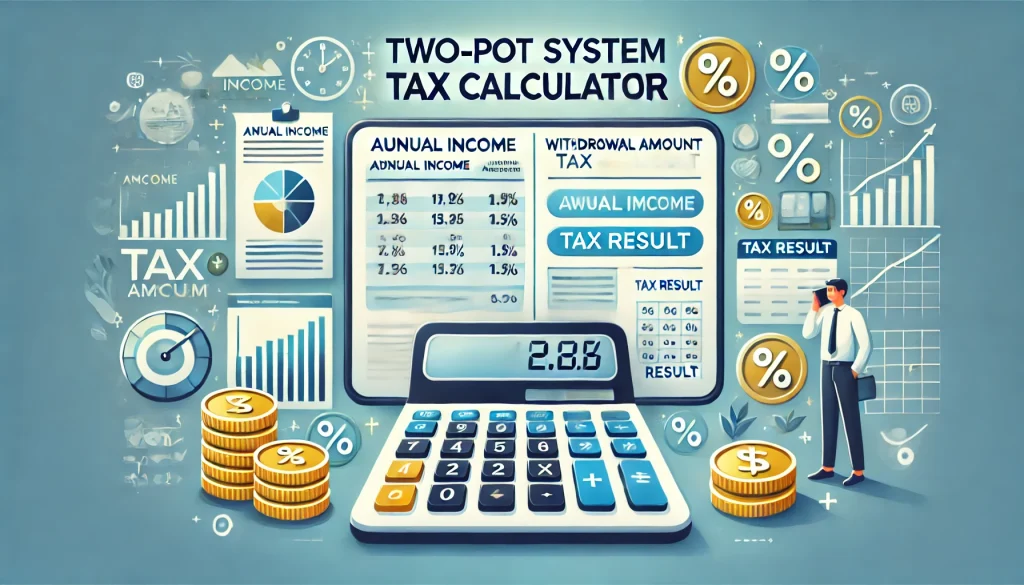
Two-pot system tax calculator Are you feeling overwhelmed trying to calculate the tax on withdrawals from the two-pot system? Don’t worry—we’re here to guide you through it and help you find a tool that makes calculating your tax easy. Withdrawals from the savings pot are taxed at your marginal rate, which is often higher than the tax rate applied to early retirement fund withdrawals. Example: Mr. X’s Withdrawal Let’s look at an example. Suppose Mr. B resigns and decides to withdraw his total retirement fund credit of R50,000. Under the current system, Mr. B would pay 18% tax, amounting to R4,050 (since the first R27,500 is tax-free, and the balance is taxed at 18%). Under the new two-pot system, if Mr. B, with an annual salary of R300,000, withdraws R50,000 from his savings pot, he will incur 26% tax—amounting to R13,000. This significant difference is because the R50,000 withdrawal gets added to his taxable salary, raising his marginal tax rate to 26%. Where can you get the tax calculator? Log into your filing and click on the Two-pot Calculator. You can also get the calculator directly on the SARS website(click to view tool). On the next window, you will be asked to enter your details: Tax number Name and surname How much you earn per annum How much you plan to withdraw Enter these details and click next The next window will ask you how you would like to receive OTP. Choose the appropriate method for yourself, and ensure that your email and tax number are correct. Once you receive your OTP, your tax result will be displayed as below: You can recalculate the result by repeating the process. Considerations: Why you should not withdraw from the two-pot system Should I withdraw from the two-pot system, you might ask. We think you might want to consider not withdrawing from the two-pot system: Here’s why: If you withdraw now, you’ll be subject to tax at marginal rates. Additionally, if you’re unable to replace those retirement savings, you could face challenges and potentially fall short of funds when you retire. As an alternative, consider using your discretionary savings or emergency funds first. Withdrawal from the two-pot system should ideally be a last resort. If you have any questions or need assistance, please feel free to reach out. We’re here to help make this process as smooth as possible for you.
Which Documents Do You Need to Submit to SARS for Your Tax Return?
Which Documents Do You Need to Submit to SARS for Your Tax Return? When you submit your tax return and receive an assessment (ITA34), you may also receive a letter from SARS asking you to provide supporting documents. To check if you have been selected for verification, review your ITA34. Look for the “Compliance Information” section, which indicates whether you have been selected for audit or verification with a “Y” (Yes) or “N” (No). If you see an “N,” you can breathe a sigh of relief—SARS likely doesn’t need anything further from you this tax year. However, if there is a “Y,” it means SARS requires evidence or documentation to back up the amounts reported on your tax return. Unfortunately, this is becoming more common. This is why we think you should always put your tax documents together before the tax season starts. From our experience, SARS can request a wide range of documents. The best way to prepare is to review your tax return thoroughly and ensure you have supporting documents for each item reported. The SARS letter will usually specify the documents needed, so read it carefully and make sure you provide everything requested. To simplify the process and ensure you’re well-prepared, we’ve put together a table that outlines the most common expenses and the specific supporting documents SARS might request, tailored to the type of taxpayer you are: Expense Salaried Employee Commission Earner (more than 50% of income from commissions) Sole Proprietor / Freelancer / Independent Contractor Depreciation on Business Assets (e.g., laptop) – Letter from employer stating you can use a personal laptop for work – Proof of purchase (invoice) – Calculation of wear and tear – Letter from employer stating you can use a personal laptop for work – Proof of purchase (invoice) – Calculation of wear and tear – Proof of purchase (invoice) – Calculation showing how wear and tear was calculated and apportioned between business and personal use Medical Costs – Medical Aid Tax Certificate – Invoices from doctor/pharmacy and receipts (POPs) for qualifying expenses not submitted to Medical Aid – Medical Aid Tax Certificate – Invoices from doctor/pharmacy and receipts (POPs) for qualifying expenses not submitted to Medical Aid – Medical Aid Tax Certificate – Invoices from doctor/pharmacy and receipts (POPs) for qualifying expenses not submitted to Medical Aid Uber Costs – Cannot claim – Uber receipt (email) – Uber receipt (email) Home Office – Letter from employer stating you can work from home and % time spent there – Calculation showing apportionment – Supporting invoices – Letter from employer stating you can work from home and % time spent there – Calculation showing apportionment – Supporting invoices – Calculation showing apportionment – Actual invoices supporting claim (electricity, water, rates, bond statement, rental invoice, etc.) Bank Charges – Cannot claim – Bank statement reflecting bank charges for your business account – Bank statement reflecting bank charges for your business account Entertainment – Cannot claim – Schedule of entertainment expenses detailing names of attendees, the purpose of the meeting, etc. – Restaurant invoices/receipts – Schedule of entertainment expenses detailing names of attendees, the purpose of the meeting, etc. – Restaurant invoices/receipts Travel – Logbook with details of business mileage – Vehicle purchase invoice (if applicable) – Fuel, maintenance, license, and insurance invoices (if actual costs are claimed) – Logbook with details of business mileage – Vehicle purchase invoice (if applicable) – Fuel, maintenance, license, insurance invoices – Logbook with details of business mileage – Vehicle purchase invoice (if applicable) – Fuel, maintenance, license, insurance invoices Telephone – Cannot claim – Sample of actual monthly invoices – Calculation showing how total expenses were apportioned between business and personal use – Sample of actual monthly invoices – Calculation showing how total expenses were apportioned between business and personal use Key reminders: SARS does not accept schedules or lists of expenses on their own—you must provide scanned copies of the actual invoices or receipts. Make sure that your supporting documents match the total expenses you’ve claimed on your tax return. Submit all calculations, ensuring they are clear, detailed, and easy for SARS to understand during their review Ready to make tax season stress-free? Let us help you get your documents in order and avoid costly mistakes. Contact us today and get expert guidance on all your tax needs—because your peace of mind is priceless!
Can SARS check your bank statement?

Can SARS check your bank statement? Some people believe they can hide information from SARS. However, it is in your best interest to declare all income you received during the year of assessment, as it is highly likely that SARS knows more about your finances than your spouse or family members do. In some developed countries, a taxpayer’s tax return is linked to their bank account. This way, the taxpayer is obliged to account for everything that happens in their bank account on their tax return. SARS is developing a similar system. SARS now requires certain taxpayers to explain why the revenue declared on their tax return does not match the deposits in their bank accounts. Unsatisfactory answers have led to additional estimated assessments and, in some cases, heavy penalties being imposed. For example, if a taxpayer declares R1.5 million on their tax return but the deposits in their bank accounts suggest a revenue of R5 million, the taxpayer must explain to SARS why the revenue collector should not raise additional assessments for the “under-declared income.” If you do not respond or do not supply adequate reasons as to why the deposits were not declared, or that they relate to loans and inter-account transfers, or potentially from other non-taxable income, then SARS may raise these assessments. How Does SARS Know What’s on Your Bank Statements? When you submit your tax return, SARS may request you to submit your bank statements as part of the supporting documents. Additionally, SARS has had access to taxpayers’ information from third-party data providers such as banks and other financial institutions since 2012. What Happens if You Do Not Agree with SARS Assessments? The burden of proof lies with the taxpayer. SARS has dispute mechanisms that can be used to challenge these assessments. These procedures often take time and may require supporting documents to support your claims. But SARS may require the taxpayer to reconcile amounts line by line and to explain each line with evidence. For example, why a deposit stands out, why it was made, and why it was not included in the taxpayer’s income. What if SARS is Correct but I Cannot Pay Them? It is important to note that SARS can instruct the taxpayer’s bank to deduct monies from an account and pay it over to SARS. Therefore, it is important for a taxpayer to approach SARS and request a compromise or a repayment plan if they feel they are not in a position to settle the amounts due. Common Questions: Does SARS have access to all my bank accounts? Yes, SARS can access your bank account information through third-party data providers like banks. Do banks report deposits to SARS? Banks are required to report certain deposits to SARS, which helps them verify your declared income. How does SARS verify your bank account? SARS verifies bank accounts by cross-referencing data from your tax return with information provided by banks. Who can see my bank account? Besides you and your bank, SARS can access your bank account details for tax compliance purposes. Ensure Your Compliance: Stay proactive and ensure your tax affairs are in order. Contact us today for expert guidance and support to ensure you stay compliant and avoid unnecessary penalties and stress. Let us help you navigate SARS requirements with ease. Leave a message Subscribe now:
How will the two-pot system be taxed in South Africa?

How will the two-pot system be taxed in South Africa? South African pension fund members who are considering accessing a portion of their retirement savings under the two-pot system must realize that it is a costly way of getting money. Withdrawals from the savings pot will be taxed at the marginal rate, which is significantly higher than the existing tax rate applicable to early retirement fund withdrawals. Example: Mr. X’s Withdrawal Suppose Mr. B resigns and decides to withdraw his total retirement fund credit of R50,000. Under the current system, Mr. B would pay 18% tax, amounting to R4,050 (since the first R27,500 is tax-free, and the balance is taxed at 18%). Under the new two-pot system, if Mr B, with an annual salary of R300,000, withdraws R50,000 from his savings pot, he will incur 26% tax – amounting to R13,000. This significant difference is because the R50,000 withdrawal gets added to his taxable salary, increasing his marginal tax rate to 26%. What is the two-pot system? Under this system, a retirement fund member’s contributions are divided into a savings component, which is accessible once per tax year, and a retirement component. Additionally, for existing retirement fund members, a third component known as the vested pot will include all contributions made up to 31 August 2024. What is the maximum withdrawal from the two-pot retirement system? The 4% rule limits annual withdrawals from your retirement accounts to 4% of the total balance in your first year of retirement. If you retire with R1 million in savings, this means you can only take R40,000. This rule is a “safety rule” to ensure that you do not run out of savings during a 30-year retirement period. What is the new law on pension withdrawal in South Africa? From 1 September 2024, South African workers who contribute to a retirement fund will be able to withdraw a portion of their retirement savings. The two-pot system allows you to access a part of your retirement savings before you retire. Here’s a simplified breakdown of the two-pot system: Vested Component: This includes all retirement savings accumulated up to 31 August 2024. Existing rules apply for accessing these funds, such as upon leaving your employer, emigrating, or in cases of disability or death. Upon retirement, these funds are available as a lump sum. Retirement Component: Two-thirds of contributions made from 1 September 2024 onwards will be allocated here. These funds are locked until retirement, at which point they must be used to purchase a retirement income product. Savings Component: One-third of contributions from 1 September 2024 will go into this component, initially funded by a once-off allocation from the vested component (up to 10% of its value at 31 August 2024, capped at R30,000). You can access these funds annually, subject to a minimum of R2,000. At retirement, this can be taken as a lump sum or used to purchase a retirement annuity income product. Who is it for? Any South African who has a pension fund, provident fund, retirement annuity, or preservation fund. Conclusion While the two-pot system offers flexibility, the substantial tax implications necessitate careful consideration. Fund members should utilize available resources, such as tax simulators, to make informed decisions about whether to withdraw from their savings pots. The potential financial impact, both immediate and long-term, underscores the importance of evaluating all factors before accessing retirement savings. Navigating the complexities of the two-pot retirement system and its tax implications can be daunting. To ensure you make the best financial decisions for your future, take advantage of available resources like tax simulators and consult with financial advisors. Don’t let unexpected tax burdens catch you off guard. Plan ahead, stay informed, and make the most of your retirement savings. Leave a message or subscribe to our newsletter for more insights and updates on retirement planning and tax strategies. Your future self will thank you! Leave a message Subscribe now:
Maximizing Your Solar Tax Rebate 2024: A Guide for Homeowners and Renters

Solar tax rebate To encourage investment in clean energy, the solar energy tax rebate is available for one year, providing an opportunity for individuals to save on their tax liability when installing solar panels. Below is a comprehensive guide on what you need to know about this rebate and how to claim it in the 2024 tax season. Eligibility and Rebate Details Individuals who pay Personal Income Tax and install new, unused photovoltaic (PV) panels are eligible to claim a rebate of 25% of the panel costs, capped at R15,000. However, this rebate is only applicable for solar installations at private residences, not business premises. Claiming the Rebate on Your Tax Return To qualify, include the total cost of the PV panels when completing your 2024 Income Tax Return (ITR12). SARS will automatically calculate the rebate based on the information you provide, so you do not need to perform the calculation yourself. Calculation Examples Example 1: If you purchase 10 PV panels at R4,000 each (totalling R40,000), you can claim 25% of the cost, equating to R10,000. Example 2: If you purchase 20 PV panels at R4,000 each (totalling R80,000), 25% of this amount is R20,000. However, since the rebate is capped at R15,000, the claimable amount will be limited to R15,000. Qualifying Criteria To qualify, the following conditions must be met: New and Unused Panels: Only panels brought into use for the first time by the taxpayer between 1 March 2023 and 29 February 2024 qualify. The panels can be part of a new installation or an addition to an existing solar system. Minimum Capacity: Each panel must have a capacity of at least 275 W. Installation Location: Panels must be installed at your primary residence, used mainly for domestic purposes. Connection Requirement: The system must be connected to the residence’s distribution board. Required Documentation To claim the rebate, keep the following documents ready for SARS verification: Electrical Certificate of Compliance (COC): This must include the certificate number, registration number, and contact details of the contractor who completed the installation. Invoices and Proof of Payment: The invoice should detail the number of panels purchased, the cost per panel, and the wattage of each panel. If applicable, provide separate invoices for different components. Installation Proof: Evidence of the installation date and the first use of the panels should be included in the COC. Proof of Domestic Use: Provide evidence that the installation is at a primary residence used for domestic purposes. This can be ownership documents or proof of property use, such as rental agreements or utility bills. Important Notes The rebate applies exclusively to the cost of PV panels and does not cover inverters, batteries, or other components of the solar system. Eligibility for Renters: Renters can claim the rebate, as property ownership is not a requirement. However, only the individual who paid for the panels is eligible to claim the rebate. Ready to take advantage of the solar energy tax rebate? Don’t miss out on this opportunity to save on your taxes while investing in clean energy. For expert assistance with your tax return and to ensure you claim the maximum rebate, contact us today! Our team of registered tax practitioners is here to help you navigate the process smoothly. Our Services At Eva Financial Solutions, we offer a range of services designed to support your financial and business needs: Tax Services: Expert tax planning, preparation, and filing to maximize your savings and ensure compliance. Accounting & Bookkeeping Services: Accurate financial record-keeping, monthly accounting, and financial statement drafting. Business Advisory Services: Strategic management reporting, budgeting, cash flow management, and business valuations. CIPC & Secretarial Services: Professional company registrations, annual returns, director changes, and deregistration. Payroll-Related Services: Comprehensive support for employment contracts, compliance Let us take the stress out of managing your finances—contact us today to learn how we can help your business thrive!